More than fun and money. Worker Motivation in Crowdsourcing â A study on Mechanical Turk.
Money,
pastime, task autonomy, social contact, ... Have you ever wondered why people
spend time on paid crowdsourcing markets such as Amazon Mechanical Turk? This
was the research question of the study which Nicolas Kaufmann, Thimo Schulze
and Daniel Veit executed in 2011.
The term crowdsourcing was defined by Howe in 2006 as the outsourcing of a function or task
traditionally done by a designated agent to an undefined network of labourers
carried out by a company or a similar institution using a type of open call.
Nowadays they use this term to refer to phenomena such as open innovation,
co-creation and knowledge aggregation.
The study executed by the authors of
this paper focused on the paid
crowdsourcing market Amazon Mechanical Turk. They wanted to determine the
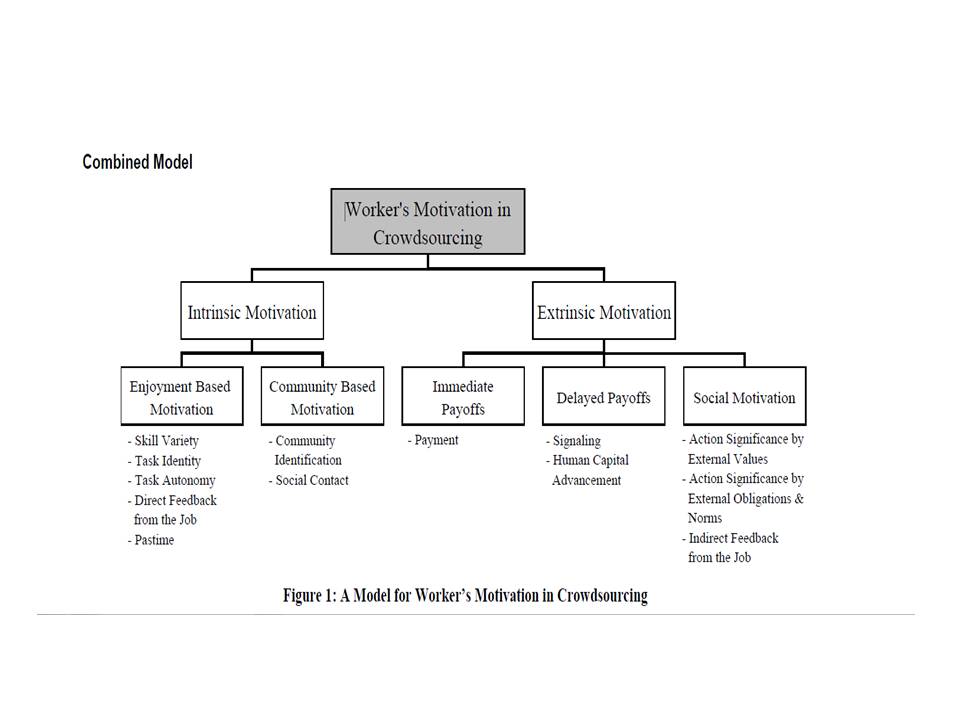
motivation of the people who are active on this crowdsourcing platform. Therefore they built a special model that
combines different existing motivation models like work motivation and
education theory and the Self-Determination Theory.They called this model: the Workers Motivation in Crowdsourcing model.
The authors
posted a task on Mechanical Turk to collect their data. The task called
Scientific survey about Mechanical Turk usage. The task took 10 to 15 minutes
and they paid the respondents $0.30.The
results of the survey showed that a lot of people are motivated by the payment,
this is surprising because the overall wage level on the platform is only
$1.38/h. Furthermore the pastime motivation is only important for occasional
workers. The power workers (the people who spend the most time on the platform)
have more intrinsic motivation such as skill variety and task autonomy.
Yasmine De
Wulf
Kaufmann, N.,
Schulze, T.& Veit D. 2011. More
than fun and money. Worker Motivation in Crowdsourcing A study on Mechanical
Turk. Proceedings of the seventeenth
Americas Conference on Information Systems, Detroit, Michigan, August 4th-7th
2011. 11p.
Innovation with Living Labs: a Conceptualization of Learning from User Experiences
Mahr, D. & Schuurman,
D. 2011. Innovation with Living Labs: a
Conceptualization of Learning from User Experiences. European
Marketing Academy, 40th, Proceedings, 6
The lack of correspondence between
customer needs and product characteristics represents a key reason for
failed innovations. This study researches customer involvement in innovation processes
by the use of Living Labs. It focuses on two
main research questions:
(1) What defines a Living Lab and how does it foster knowledge creation?
(2) What is the impact of customer characteristics on knowledge created
through Living Labs?
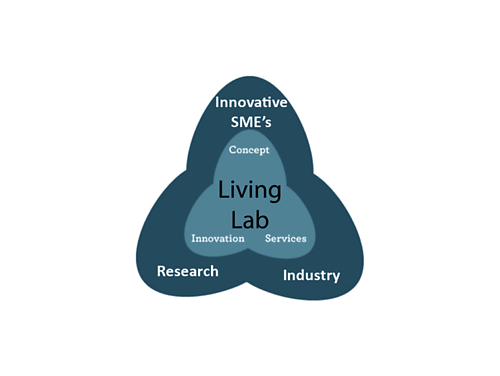
The concept of Living Labs is
a process where firms observe customers in their own real-life setting when
they develop solutions to new unprecedented problems and discover new usage
possibilities. The firms learn from those use experiences, generalize the
findings and modify products for new trials.
The advantages and disadvantages as well as the characteristics which
distinguish Living Labs from other research approaches are explained in the
paper.
Also the type of involved
customers determines the success. Lead users dispose of useful knowledge
for the innovation process. They detect needs far before other customers and
they benefit by obtaining a solution to them. Often the role of so-called
defectors unsatisfied users -is
underestimated.
The authors conclude with
proposals of future research opportunitieslike research on the design and use of Living Labs or finding out the importance
of the role of Living Labs in the requirement of customers latent needs. In my
opinion the authors ignore the negative aspect of attracting voluntary
participation. Sarah Inghelbrecht