|
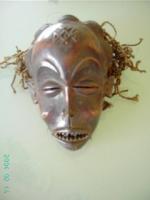
African art of the Chokwe Tribe. Mask tribal significance.
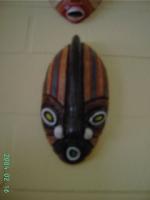
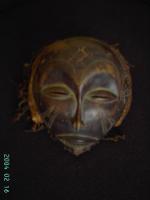
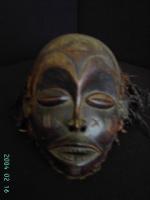
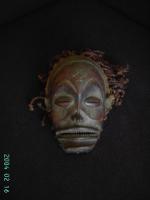
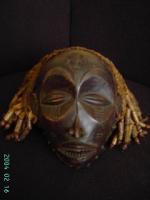
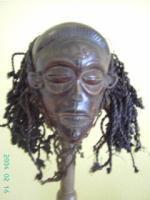
 The mask to the left was used during the inauguration ceremony of the king. The ceremony is an important investiture event. During the ceremony sacrifices are made to the ancestors. According to Chokwe belief, ancestral spirits play the crucial role of providing for living descendants. The ancestral characters also protect the peoples from intruders or evil (wanga) supernatural elements. The Chokwe people influenced the art of many neighboring tribes, including the Lunda, Mbunda, Lovale and Mbangani. The mask to the left was used during the inauguration ceremony of the king. The ceremony is an important investiture event. During the ceremony sacrifices are made to the ancestors. According to Chokwe belief, ancestral spirits play the crucial role of providing for living descendants. The ancestral characters also protect the peoples from intruders or evil (wanga) supernatural elements. The Chokwe people influenced the art of many neighboring tribes, including the Lunda, Mbunda, Lovale and Mbangani.
The most powerful and important Chokwe mask is known as chikunga. Highly charged with power and considered sacred, chikunga is used during investiture ceremonies of a chief and sacrifices to the ancestors. These masks are made of barkcloth stretched over an armature of wickerwork, covered over with black resin and painted with red and white designs. Only the current chief of a group wears Chikunga.
The mukanda masks play a role in male initiation. The mukanda is an initiatory institution through which religion, art, and social organization are transmitted from one generation to the next. Mukanda training lasts from one to two years. Boys between the ages of about eight and twelve are secluded in a camp in the wilderness, away from the village. There they are circumcised and spend several months in a special lodge where they are instructed in their anticipated roles as men. As part of their instruction, the boys are taught the history and traditions of the group and the secrets associated with the wearing and making of masks.
In the past some masks played important roles in religious beliefs and institutional practices, many other Chokwe masks have come to be used primarily for entertainment. Itinerant actors wearing these masks travel from village to village, living on gifts received at performances. Most masks are carved from wood. The most popular and best-known entertainment masks are chihongo, spirit of wealth, and pwo, his consort.
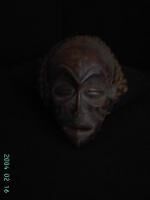
Gaunt features, sunken cheeks, and jutting beard of an elder characterize a chihongo mask. Chihongo was formerly worn only by a chief or by one of his sons as they traveled through their realm exacting tribute in exchange for the protection that the spirit masks gave. While Chihongo brings prosperity, his female counterpart, pwo, is an archetype of womanhood, an ancestral female personage who encourages fertility. As an ancestor, she is envisioned as an elderly woman. The eyes closed to narrow slits evoke those of a deceased person. The surface facial decoration is considered female. Recently pwo has become known as mwana pwo, a young woman. It represents young women who had undergone initiation and are ready for marriage.
Principles of social and political organization, history, philosphy, religion and morality are presented publicly through various types of masquerades. The king or Mwana Ngana governs the Chokwe people. The king distributes hunting and cultivation areas, and also governs the Chokwe people. The male Mugonge and female Ukule societies regulate social life in the village. The Chokwe people are vigorous and courageous hunters and agriculturists. Their dynamic spirit is reflected in their art.
The Chokwe people founded several kingdoms, each headed by a king. Around 1860, the Chokwe people were hard hit by a drought and famine. They migrated back towards the south and settled in Angola and in Zaire, at the source of the Kwangi, Kasai and Lungwe rivers.
The Chokwe and related peoples have been greatly affected by modern conflicts, despite the adversity they continue to pursue their own ways. In militarized areas in Angola and Congo, as well as in Zambian refugee camps, they practice initiation, divination, and healing rites. Some Chokwe chiefs have been displaced by war, and their authority has been challenged by modern governments political goals. Nevertheless, Chokwe chiefs continue to represent traditional and sacred authority.
|